


.png)


Preparing to Apply for Physiotherapy Degrees... Tips for Physiotherapy University Applicants from a Physiotherapist
- Physioing

- May 6
- 8 min read
Updated: Jun 17

Introduction
Want to study physiotherapy at a UK university but not sure how to stand out in your personal statement and admissions interviews? If you're preparing to apply for physiotherapy degrees, we're here to help with tips for physiotherapy applicants from a physiotherapist.

Shadowing & Work Experience - Why is it Important?
One of the most common reasons applicants aren't offered interviews is because of a lack of shadowing or work experience. To demonstrate some understanding of the profession and healthcare environment, physiotherapy university applicants are required to complete relevant work experience or shadowing. Why? Physio involves many specialisms, whilst some areas are clinic or sports based, many in contrast to this are medical based. (Check out our short below for an insight into some of the specialisms out there). Universities want to give places to students who are prepared for the realities of the degree and the 1,000 hours minimum of practical placements they'll need to complete.
Working in medical and healthcare environments isn't for everyone but it is a requirement of all physiotherapy students to work across a variety of specialisms to qualify as a physiotherapist. This is especially relevant to remember for students who already know where they wish to directly specialise, e.g. into sports and musculoskeletal physiotherapy (MSK), as you won't be able to complete all your placements in one physio specialism.
Physiotherapist is a protected job title and an accredited physiotherapy degree is required to practice using this title, there are no alternative qualifications available to achieve this registration . The traditional core areas of physiotherapy that you will definitely study are MSK (musculoskeletal) physiotherapy, neurological physiotherapy and cardiorespiratory physiotherapy, students will usually cover these three areas on practical placements and most definitely in their exams. UK universities partner with many providers of practical placements for physio students, some are very niche and unique. If you spend time shadowing a physio ask them about their physio placements to learn more.

Shadowing & Work Experience - Book it Early
Opportunities for work experience and shadowing vary in different areas and there may be competition for limited spaces, especially in hospitals. To avoid missing out arrange this sooner rather than later to increase your chances of securing something when there is less demand. It can be beneficial to arrange and possibly complete your shadowing in the first year of your A-levels, when you first start your Access course, or the year before you apply for university. This also provides extra time for you to potentially complete more than one type of experience if you'd prefer.

Shadowing & Work Experience - What Type?
Most hospital websites provide details on the work experience programs they offer and how to apply. Get researching early if you can, as there are usually set deadlines once or a few times a year to apply. Other great opportunities to consider include private physios, community hospitals and specialist rehabilitation/support units (neurological, learning disabilities etc). Some care homes, sports teams and privately run schools are also supported by physiotherapists.

Reflect on your Work Experience or Shadowing in your Personal Statement
Whilst a lot of emphasis is placed on shadowing experience, do not rely purely on shadowing to get you through the application process. Studying physiotherapy requires the ability to reflect and learn from your experience. Demonstrating this in your personal statement will show you already possess some physio qualities. A favourite at our university was The Gibbs' Reflective Cycle. If you're trying to keep things concise include what you did, explain what you learnt and how it would assist you in your future physio career. Getting in the habit of reflecting early on will definitely be beneficial when you're at interview stage. Many universities will ask you at the end of your interview to write a quick reflection about how you think you performed.

Pre-learning - Anatomy
Some but not all universities have a basic anatomy entrance test, but it's worth investing in learning the basics before starting university. You'll need to know it for your degree studies. We'd recommend learning the names and locations of the bones, muscles and organs of the body and the anatomical movements, for a good foundation. The great news is, there are numerous paid and free options for anatomy studies to suit all learning styles. Check out our Anatomy & Physiology Revision page for some recommended resources, site and products. If you've got the time and have done well building a good foundation of knowledge, further your learning by studying basic physiology, anatomy and functions of the central nervous system or origins and insertions of the muscles.


Pre-learning - NHS, CSP & HCPC
Ensure you've got some essential background knowledge for university interviews regarding the NHS (National Health Service), CSP (Chartered Society of Physiotherapy) and the HCPC (Health Care Professionals Council) as these are popular interview topics:
NHS - Currently the largest employer of qualified UK physiotherapists, all student physiotherapists will have some NHS placements as part of their degree. Aim for a brief understanding of the history of the NHS, the NHS long term plan, the NHS constitution and NHS values (reflect on how they relate to you). Don't worry about getting too bogged down in the finer details or try to remember everything, it's more about demonstrating an awareness.
Note: NHS Wales and Scotland have some differing policies and approaches compared to NHS England, make sure you research as necessary.
CSP - The CSP is a membership body for qualified physios, physio students and physio support physio workers. The society accredits physiotherapy degrees, ensuring taught programmes meet the standards required to use the protected title of Physiotherapist. Memberships provide liability insurance and other benefits. There are various networks and branches based on specialisms and locality and access to courses and news via the website.
HCPC - The HCPC sets the standards and approves the programmes for many health and care professionals in the UK, including physiotherapists. To legally use the title of Physiotherapist, you must have passed a physiotherapy degree and applied to the HCPC to declare you meet the Standards of Proficiency and you'll be added to the register. This register is accessible to the public and you can look up any registered physiotherapist on it. Every two years, qualified physiotherapists must reregister by declaring that they still meet the standards of proficiency and they will remain on the register. To ensure they remain current and up-to-date, physios complete and record CPD (continuing professional development) which the HCPC may request to audit whilst they are on the register. Whilst you won't need to memorise the Standards of Proficiency it is worth looking through it to get an idea of what the standards are so you can demonstrate an awareness in interviews.

Pre-learning - Physiotherapy Specialisms and Work Environments
Physios are required to carry out 1,000 hours minimum of practical placements as part of their degree and universities will assign student placements to ensure a range of experience is gained.
Physios can be found in acute hospitals and community hospitals and in some care homes, sports centres, doctors surgeries, private schools, specialist schools, military establishments, research departments and educational roles and more! Specialisms include musculoskeletal, neurological, cardiorespiratory, orthopaedics, elderly, medical, palliative, mental health, sports rehabilitation, Women's health, paediatrics and even more! Prepare yourself by researching physio jobs and working environments in your local area or around your chosen universities. Demonstrating this awareness in your personal statement and interview will highlight to admissions staff that you have an understanding what a physiotherapy career looks like, rather than just an understanding of one or two of the more well known roles.

Pre-learning - Complete some Physio Webinars (if you get chance)
If you get the chance between revision (and everything else), it can be a useful insight into the world of physio to check out a webinar or two. Many sites offer free short webinars, check out our Physioing's directory of resources organised by specialism to see what sort of specialisms you may encounter on a physiotherapy degree and some of the resource providers. The advantage of looking at this sort of material early is you'll start to see how anatomy and physiology terminology is used and get an insight into how evidence based practice and clinical reasoning are applied. If you do any of this type of pre-learning, mention it in your personal statement and at interviews. This can be a real conversation starter at interviews if you've already started looking into this type of material.

Follow Physios & Physio Related Organisations on Social Media
Keep up-to-date with physio news and views, get an idea of typical days, routines, specialisms and types of work by following physios and physio related organisations on social media. Many physio students are also active on social media documenting their typical days, placements and revision techniques. Lots of physios post about new research papers, techniques and even exam tips. Try to follow a mix of creators across the specialisms to give you an idea of the breadth of physio roles.

Complementary Skills - People Skills, Leadership, Empathy, Organisation, Timekeeping...
Physiotherapy is a demanding but rewarding career, involving social skills, empathy, people management, leadership, the ability to advocate for people, organisation and timekeeping skills, just to name a few! Think about the attributes and abilities required for the role and how you may already fit these requirements or have relevant experience and refer to these in your personal statement with examples (this fits into question one and three of the personal statement). For further insight into requirements of specific roles check out NHS jobs and look through the person specifications.

Start Practising for Interview Questions Now
Start practising for interviews early, whether it's with friends, family, pets, talking to yourself or simply running through answers in your head. The more practised you are, the more likely you'll be able to blurt out cohesive answers if you start to feel nervous at the real thing. As a starting point Studential have a physiotherapy question bank and The Student Room includes forums for physio applicants. Make sure you do your own research as interviews can be group based, mini interview stations, individual chats, etc it's the unis choice.
Whilst some universities will openly publish information on what format and materials their interviews will be based on, others universities may provide minimal details and leave the format a surprise. It's worth doing your research to see what you can find out but don't be concerned if you can't find out much about some unis. If you're well practised the format of the interview won't be a distraction.
UCAS Personal Statements - Don't Overthink Where to Include Things in the 3 Question
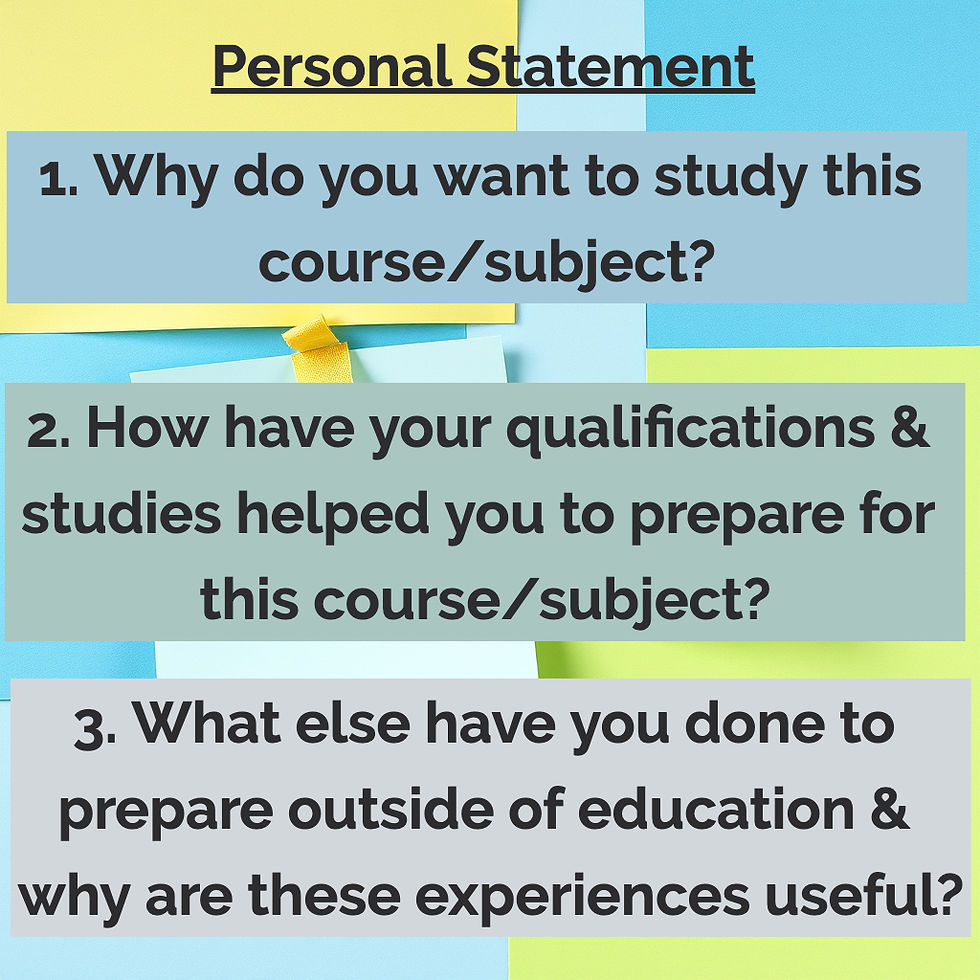
UCAS designed the three question, personal statement format to make it easier for applicants across all qualifications to prepare a personal statement. With this is mind don't stress too much about the specifics of what examples and information to put where. UCAS themselves have even said 'there's no right or wrong section to include something in'. Aim for a personal statement that is individual to you (not generic), what makes you a future physio and why and get some of that enthusiasm, passion and understanding across to the admissions teams!
In Conclusion...

Universities are looking for potential students with enthusiasm, a genuine interest in the subject and the ability to demonstrate an understanding of physio roles, regulatory bodies and working environments. Follow our helpful tips to support you with material for your personal statement and interviews, hopefully setting you up for success:
Pre-learning - Physiotherapy Specialisms and Work Environments
Pre-learning - Complete some Physio Webinars (if you get chance)
Follow Physios & Physio Related Organisations on Social Media
Complementary Skills - People Skills, Leadership, Empathy, Organisation, Timekeeping
UCAS Personal Statements - Don't Overthink Where to Include Things in the 3 Question Format
Best of luck with your physiotherapy degree applications.

Promotions & Affiliations: Please note whilst it is free to appear in the directory, this site includes some promoted products, services & sponsored articles which are clearly labelled. As an Amazon Affiliate we earn from qualifying purchases.
*Details and information relevant at date published.
Useful Links from Article (listed in order of appearance):